🎯 About This Game
Ternio is an original three-player adaptation of Reversi. It features a larger 9×9 board, a unique starting position, and a crucial rule change: you can only capture stones of a single opponent color per direction. This creates fresh strategic challenges while preserving the essence of the classic game.
📖 Rules of Ternio
Overview: Ternio is a three-player strategy game played on a 9×9 board with red, green, and blue discs. Players take turns in a fixed sequence: Red → Green → Blue.
Setup: The game begins with a 3×3 formation in the center of the board. The starting position is slightly asymmetric to balance the turn order. Red always moves first.
Basic Move: On your turn, place a disc of your color on an empty square. To be a legal move, you must flank and flip at least one opponent disc. Flanking means your new disc and an existing disc of your color enclose a line of opponent discs (horizontally, vertically, or diagonally). All flanked discs are then flipped to your color.
The Monochrome Rule: This is what makes Ternio unique. A line of opponent discs can only be flipped if all discs in that line are of the same color. Mixed lines (e.g., blue-red-red-green-blue) cannot be captured and do not count as valid flanks. However, you may capture different colors in different directions with a single move.
Passing: If you have no legal moves, you must pass. Play continues with the next player. If all three players must pass consecutively, the game ends.
Game End: The game ends when the board is full or when no player can make a legal move. The player with the most discs of their color wins. Three-way ties are possible but rare.
🎮 How to Play
Starting a Game: Find two partners and agree on a room name. Enter a nickname to identify yourself. One player creates the room, then the other two join using the same room name.
Assigning Colors: Once all three players have joined, the room creator assigns colors to each player, which also determines the turn order (Red → Green → Blue).
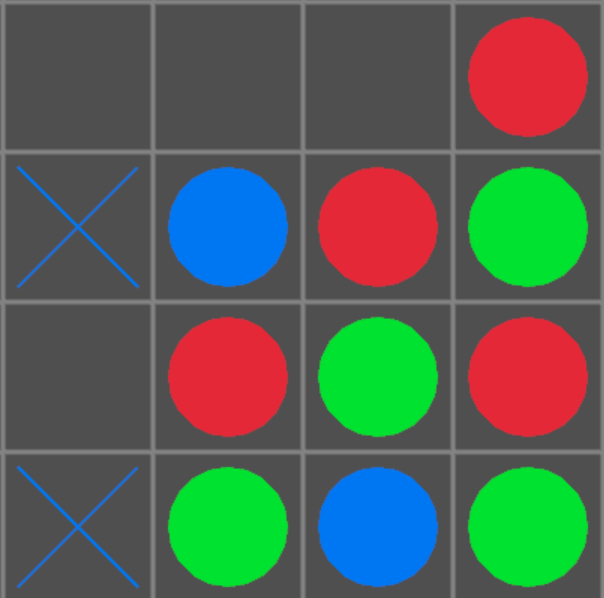
Making Moves: Available moves are shown as colored crosses on the board. Click on a highlighted square to place your disc.
Passing: If you must pass, the game automatically advances to the next eligible player. The current player is always indicated at the top of the screen.
Game End: When the game ends, the winner is displayed at the top. After a few seconds, a new game begins automatically.
💡 Strategy Tips
- Protect Your Lines: In the opening (first 4–5 moves), avoid building lines of your own stones that end at an opponent's stone. Such lines can be captured from behind, potentially eliminating you early.
- Stay Dispersed: Spreading your stones across the board gives you more options. Clustered stones are easier to surround and capture. This is, though, counterbalanced by the Monochrome Rule. Being separated by two opponents limits your degree of freedom.
- Watch the Turn Order: Always consider who moves after you. Leaving an obvious capture for the next player may be unavoidable, but avoid setting up the player who follows you directly.
- Use the Monochrome Rule: Mixed opponent lines cannot be captured. Sometimes leaving enemy stones mixed provides protection against the third player.
- Classic Reversi Wisdom: Corner control and edge stability remain important, though slightly less dominant than in two-player Reversi.
⚙️ Technical Details
The game is built entirely in Rust using the Macroquad framework and compiled to WebAssembly.
- Websockets: All communication uses websockets for reliable cross-platform connectivity.
- Client-Hosted Server: The game host runs directly in the browser.
- Relay Server: A dedicated Tokio/Axum server facilitates connections between players in different browsers.